
This article seems long, but I promise you will gain a few important insights into the passage often missed out.
"Pinchas, (Phinehas in most English translations) the son of Eleazar, the son of Aaron the High Priest..." (Num 25:11).
What do you read?
You might assume that Pinchas is automatically a priest, since his grandfather was the High Priest. It seems logical that Pinchas simply inherited the priesthood according to God's ordinance of "Aaron's sons" (Ex. 29:9; Num. 3:10).
But here is the surprise.
Pinchas was growing up feeling left out, observing the sacred, life-threatening duties his granddad, his father, and his uncle Ithamar performed. He was in awe of the high responsibility and calling of his family, and of the enormous trust the Almighty had bestowed on them for the multimillion nation.
That was his pain and his longing—to share in the same sacred calling. Yes, he could perform all the duties of a Levite (for every kohen is a Levite, but not every Levite is a kohen): serving around the sanctuary, cleaning, singing, playing the musical instruments, teaching, and assisting. He did it all faithfully. But Pinchas longed for something more intimate—the calling of his father. The Kohen. The Priest.
Then came that glorious Inauguration Day —the first of Nisan, a year after Israel had left Egypt. Mishkan and its ministers - Aaron and his four sons were anointed, and God bestowed the priesthood upon them and upon all their male descendants who would be born from that day onward.
Pinchas was a young boy.
He did not fall under that special appointment.
Oh, how he longed to draw near to the Holy One. He dreamed the highest dream a man of Israel could dream: one day like his granddad to enter behind the veil and make atonement for the nation.
Only a few months earlier whole nation stood in silence witnessing a solemn ceremony. Pinchas and his family were in the front row, watching as his father Eliezar accompanied his grandfather Aaron and uncle Moshe up the mountain. Grandfather kissed all his children and grandchildren with tears filling his eyes. Pinchas knew he would never see him again.
He adored his grandfather—for his kindness, his gentle smile, and his profound wisdom. fighting boys or quarrelling children would suddenly grow quiet the moment their grandfather appeared. He knew how to bring peace with a single word.
Three heroes disappeared into the bright light at the peak of Mount Hor. Time seemed to stop forever in waiting.
"I see two figures coming down!" somebody shouted. "One is Moses, and the other is the colorful robe of the High Priest."
"Did the Lord take my father instead of Aaron?" Fear gripped Pinchas.
Slowly, very slowly, the soft melody of the bells drew nearer. The heaviest outfit you could imagine—with its thick vestments, gold threads, the robe almost touching the ground, and the high turban. To climb the mountain dressed like that is no easy task.
In the garments of Aaron he recognised his father.
Pinchas stood stunned, filled with grief and reverence.
And this week after the evil advice of Balaam, thousands of young Hebrew men followed the seductive influence of the Moabite women into the worship of Baal Peor. Had they simply chosen to marry them, it would have been one thing. Instead, they sought pleasure by taking part in the disgusting ceremonies of relieving themselves before the stone fertility idol and bowing down to it.
"The anger of the LORD was kindled against Israel." (Num. 25:3)
God spoke to Moses and commanded the leaders of the tribes of Israel to execute those under their authority who had committed this terrible sin.
The leaders were tarrying. There were too many to kill—among them their own relatives, their own sons and grandsons. A horrific task.
Moses and the leaders stood weeping before the Lord at the entrance to the Mishkan. People were falling dead everywhere. Twenty-three thousand died that day (1 Cor. 10:8).
The very leader of the tribe of Simeon, who was supposed to guard his tribe and carry out God's judgment against idolatry, defiantly marched past the entrance of the Sanctuary before the weeping priests, leading his deadly obsession into his tent. Zimri demonstratively ushered the Midianite princess before Moses, as a rebuke:
"You got one of these; I can have one too."
A few moments later, Pinchas was already at his tent. He grabbed his javelin and rushed toward the left passage from the Mishkan to the Simeonite leader's large tent.
"He pierced both of them—the man of Israel and the woman through her abdomen. Then the plague was stopped among the children of Israel." (Num. 25:8)
How do we describe such an act?
The Bible calls it pain born of love—jealousy. I would call this act courageous, for he had to be absolutely certain that what he was doing was right. He himself had heard the thundering voice of the Almighty at Sinai proclaim, "You shall not kill." He was not the leader of the nation to carry on the command. He knowingly placed his own life on the line, fully aware that he could face the death penalty.
"Pinchas the son of Eleazar, son of Aaron the priest, has turned back My wrath from the people of Israel, in that he was jealous with My jealousy among them, so that I did not consume the people of Israel in My jealousy." (Num. 25:11)
"Behold, I give him My covenant of peace ( שָׁלוֹם shalom)…
… and it shall be for him and for his descendants after him
a covenant of an everlasting priesthood."
The priesthood of Pinchas was not inherited—it was graciously bestowed. Sometimes God's greatest gifts come but at the moment when faithfulness is proven.
Have you ever seen a king confer one of the nation's highest honors, not for academic achievement, but for a heroic deed?
The same is true here: not by bloodline, but through holy passion.
Later, in 1 Chronicles 6, we learn that from among all the grandsons of Aaron, the line of the high priesthood was established through Pinchas.
Look carefully at this picture of the Torah scroll of Num. 25:12, where God says to Pinchas:
הִנְנִי נֹתֵן לוֹ אֶת־בְּרִיתִי שָׁלוֹם
"Behold, I give to him My covenant of peace."
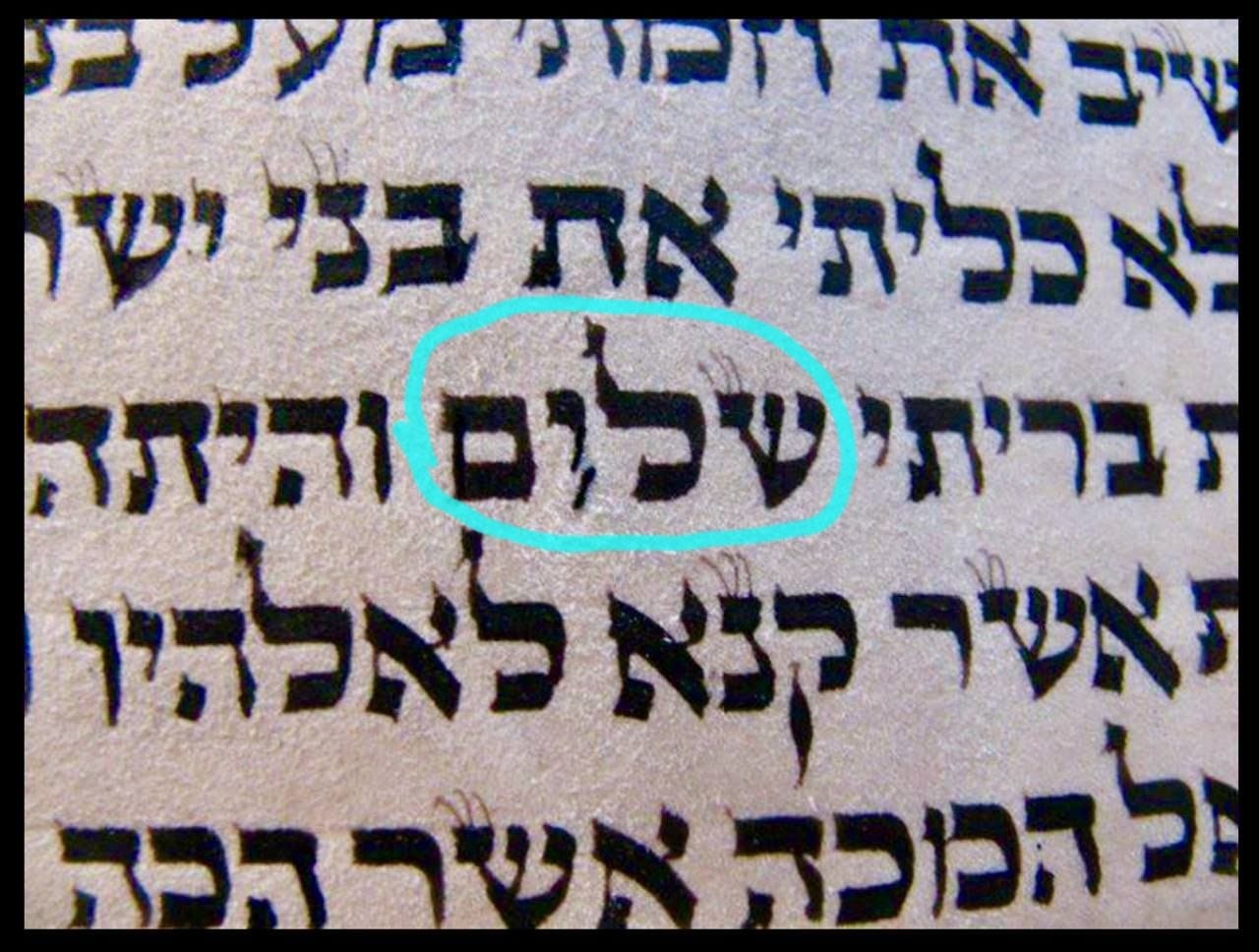
I have circled the word ( שָׁלוֹם shalom ) for those who do not read the Hebrew text.
Do you notice the broken letter vav (ו)?
Normally, the vav is written with a single vertical stroke reaching all the way down to the line.
It is not a scribal mistake. Quite the opposite—it is an ancient Masoretic scribal tradition, later preserved in most Ashkenazi and Sephardi Torah scrolls as one of the famous special letters (otiyyot meshunot), where the vav is intentionally written broken in half.
Ordinarily, if even a single letter in a Torah scroll is broken or misspelled, the scroll is considered non kosher or invalid (pasul). This is one of the very few remarkable exceptions to that rule.
What does this tradition tell us?
Phinehas stopped a terrible plague by killing Zimri and Cozbi. (In the scroll there is an extra space after the word הַמַּגֵּפָה hamaggefah - “plague”) His zeal was holy, yet it still involved bloodshed.
Therefore, the Torah writes shalom with a broken letter.
True peace obtained through the sword is still a broken peace. Even when violence is necessary to uphold righteousness, it leaves a scar.
The true fullness of shalom—peace, wholeness, and completeness—is still a future reality. It will come only with the Messiah, when righteousness and peace will embrace, swords will be beaten into plowshares, and brokenness of death will be found no more.

Member discussion: