There is a literary pattern that appears again and again throughout Scripture, called a chiasm. It is basically a structure in which the story mirrors itself.
And when you find one, the Text is almost saying aloud: Please, please pay attention to what is in the center.
Imagine two halves of a shell hiding a pearl. The outer layers protects it, but the treasure is hidden in the middle.
And guess what?
One of the first important chiasms meets us on the opening pages of Genesis — in the story of the Garden of Eden.
Let me show you.
At the very beginning, God takes the man and places him in the Garden. And what is he supposed to do there?
וַיִּקַּח יְהוָה אֱלֹהִים אֶת־הָאָדָם וַיַּנִּחֵהוּ בְגַן־עֵדֶן לְעָבְדָהּ וּלְשָׁמְרָהּ
“And the LORD God took the man and placed him in the Garden of Eden, to work it and to guard it.”
(Gen. 2:15)
לְעָבְדָהּ — le‘ovdah — to work it, to serve it
(By the way, there is another beautiful chiasm which portrays woman as the garden — but that is another story.)
Now let us jump to the very end of the Eden story.
After the sin, God sends the man out of the Garden. And what is he going to do now?
וַיְשַׁלְּחֵהוּ יְהוָה אֱלֹהִים מִגַּן־עֵדֶן לַעֲבֹד אֶת־הָאֲדָמָה אֲשֶׁר לֻקַּח מִשָּׁם
“And the LORD God sent him out of the Garden of Eden to work the ground from which he had been taken.”(Gen. 3:23)
Again we find:
לַעֲבֹד — la‘avod — to work
That repetition is the clue you should not miss - you are looking at a chiasm.
The story opens with the man placed into the Garden to work it, and it closes with the man sent out of the Garden to work the ground.
These are our bookends — Element A.
And in a chiasm, the mirrored pairs keep moving inward, each layer drawing us closer to the center.
Now the next layer.
Immediately after the man is placed in the Garden, God gives him one command: he may eat from every tree except the Tree of the Knowledge of Good and Evil.
And immediately before the man is expelled from the Garden, we find the mirror image. Now that he has eaten from the Tree of Knowledge, God says that he must not be allowed to eat from the Tree of Life also.
On one side of the chiasm: every tree is permitted except the Tree of Knowledge.
On the other side: after eating from the forbidden tree, the Tree of Life is forbidden too.
That is Element B.
Stay with me for another layer. It is getting interesting.
On one side of the chiasm Adam calls his wife ishah — Woman.
Then we are told that they were both naked, yet they felt no shame.
On the other side, Adam names his wife a second time. This time she is Chavah — Eve,
and God makes garments for them because their nakedness.
Named. Naked. Unashamed.
And on the other side:
Named again. Naked. Ashamed.
That is Element C.
One more layer, and we reach the center — the pearl.
Before the sin, there is a chain of conversation.
The serpent speaks to Eve. Eve speaks to Adam and gives him the fruit.
After the sin, another chain of conversation appears — but now in reverse order, and this time God Himself enters the dialogue.
God confronts Adam. Adam blames Eve. Eve blames the serpent.
That is Element D.
And finally we arrive at the very center of the chiasm — Element E.
וַתִּפָּקַחְנָה עֵינֵי שְׁנֵיהֶם וַיֵּדְעוּ כִּי עֵירֻמִּם הֵם
“Then the eyes of both of them were opened, and they knew that they were naked.” (Gen. 3:7)
וַיִּתְחַבֵּא הָאָדָם וְאִשְׁתּוֹ מִפְּנֵי יְהוָה אֱלֹהִים
“And the man and his wife hid themselves from the presence of the LORD God.” (Gen. 3:8)
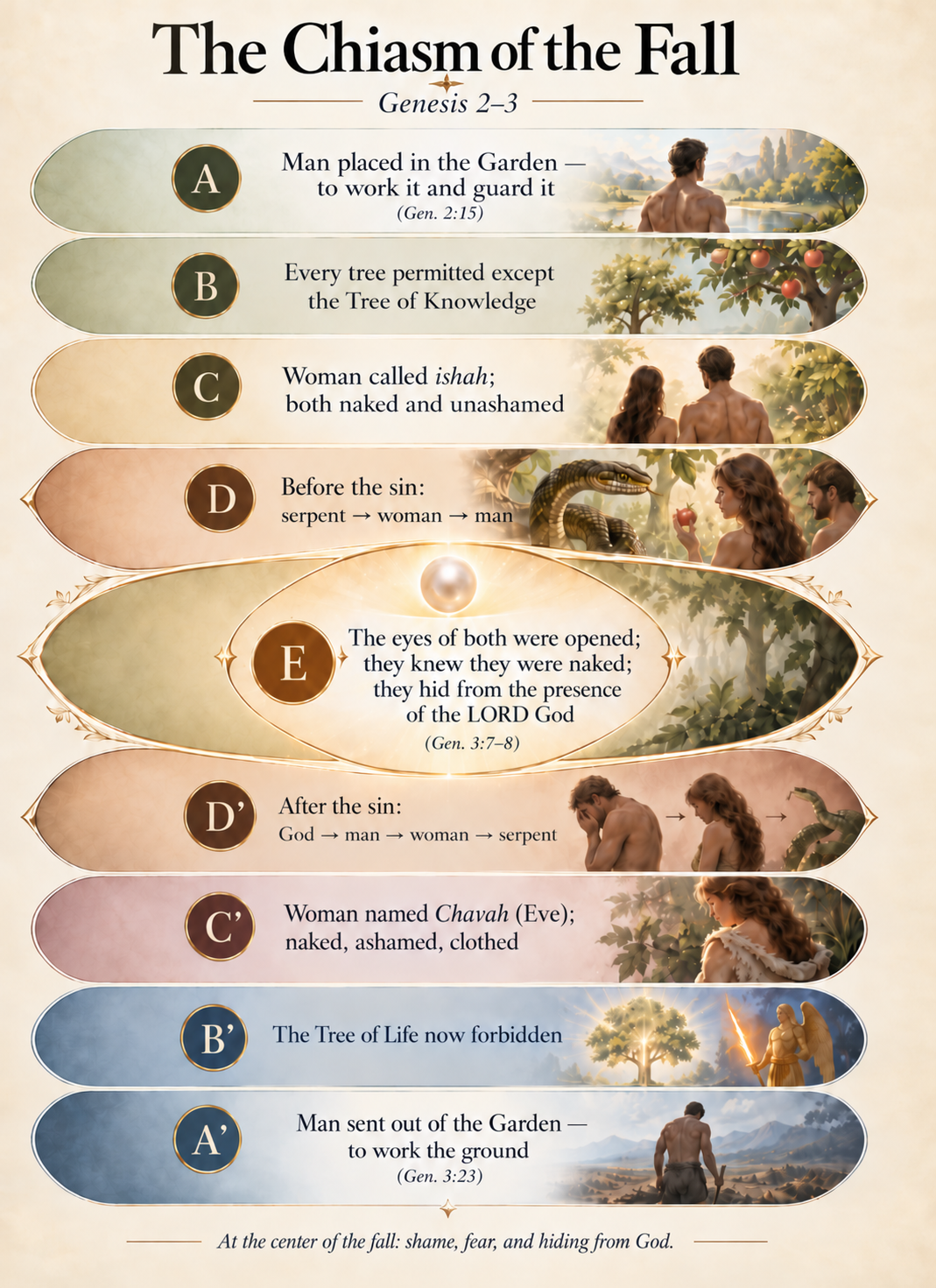
Here is the pearl. At the center of the fall stands the moment when shame and fear enters, and the human being hides from God. The relationship fractures.
And Messiah came to reverse precisely this movement. He came to bring us out from our hiding places.
Truth without hiding, repentance without shame, and belonging without fear.
He calls Adam out with the word of lamentation and grief:
אַיֶּכָּה — ayekka — Where are you
God knows exactly where they are hiding. But what, then, is He really asking?
In Hebrew there are two ways of asking “Where?” There is אֵיפֹה — eifo,
your ordinary everyday word for where, used when you genuinely want to know where something is. And then there is אַיֵּה — ayyeh,
which throughout the Old Testament is often not really a request for a location.
It is not so much “Where are you?” as “Where have you gone?”
How come you are not here?
It is more of a rhetorical question, carrying disappointment and expectation — something or somebody should be here, but is not.
Think of the Binding of Isaac, which we recently were talking about.
Abraham and son are walking up the mountain. Isaac looks around. He sees the wood, the fire — but there is no animal. He turns to his father:
הִנֵּה הָאֵשׁ וְהָעֵצִים וְאַיֵּה הַשֶּׂה לְעֹלָה
“Here are the fire and the wood, but where is the lamb for the burnt offering?” (Gen. 22:7)
אַיֵּה הַשֶּׂה לְעֹלָה
Isaac is not literally asking where his father placed it. He does not really think his father forgot the main item of the sacrifice. Rather, he is asking his father to confirm what he is already beginning to suspect:
“Am I the lamb?”
Now let us go back to the Garden.
God calls out:
אַיֶּכָּה — Ayekka
He is not asking about their location. He knows where they are.
This is ayekka — Where have you gone? How could it be? I was walking in the Garden, expecting to meet you. Why are you not here?
It is almost a lament — carrying an echo of the same word in the opening cry of the Book of Lamentations: How could it be? And God keeps asking the same question throughout history, and personally to us every day:
Ayekka? Where have you gone?
Are we able for Christ sake to come out of the hiding place and answer that call?
In Him we are made to face what we have done. In Him we are brought back to God.
The story of Scripture begins with man hiding from God. God calls in expectation and sorrow.
The story of redemption ends up with God coming to find him and fetch home back to the garden.

Member discussion: