Teach Me Your Truth

What is truth?
In a world where subjectivity is the norm and everything is relative, it’s a hard question to answer. Philosophers have pondered this question endlessly, and Pontius Pilate posed this very question to Jesus (John 18:38). There are always multiple options contending for the truth, it seems, and the source matters. So, it should not be a surprise that God offers His truth to those who wish to learn it.
Yet the struggle remains. We live surrounded by competing narratives, confident voices, carefully crafted arguments, and lived experiences that all claim legitimacy. Truth is often reduced to perspective, shaped by culture, emotion, or convenience. What feels true becomes true. What works becomes true. And what costs too much is quietly set aside. In such a landscape, the question is no longer only What is truth? but also Where does truth come from—and who has the authority to define it?
Scripture does not treat truth as an abstract concept floating above life. Instead, it presents truth as something revealed, taught, walked in, and trusted. Truth is not merely discovered; it is received. And it is received not by those who master it, but by those who ask to be led.
Make me know Your ways, O LORD;
teach me Your paths.
Lead me in Your truth and teach me,
for You are the God of my salvation;
For You, I wait all day.
(Psalm 25:4–5)
This prayer is strikingly humble. The psalmist does not claim possession of truth but seeks guidance into it. Truth, here, is a path—something one walks in over time. It requires patience, waiting, and trust. Truth is not seized; it is followed.
In Hebrew, “truth” is אֱמֶת (’ĕmet), and naturally, it is defined as something opposite of falsehood. But it also means reliability and faithfulness, firmness, stability, uprightness, integrity, and certainty. In Hebrew, the word אֱמֶת (’ĕmet) has an amazing breadth of meaning that English conveys through so many other words. That is why when we encounter this word in the biblical text, the simple idea of “something opposite to falsehood” does not always fit.
Truth in the biblical sense is not only about correct statements; it is about what can be stood upon. What holds. What does not collapse when tested by time, suffering, or moral weight. Truth is that which proves itself faithful.
For example, in Isaiah 39:8, the phrase שָׁלוֹם וֶאֱמֶת (shalōm ve‘ĕmet) probably means “peace and stability,” since the opposite of turmoil was sought. Similarly, in Joshua 2:12, the phrase אוֹת אֱמֶת (ōt ’ĕmet) should not be translated as “a sign of truth” but rather as “a sign or pledge of stability,” since, once again, not truthfulness but goodwill and reliability are being sought. In Exodus 18:21, Moses is told to select אַנְשֵׁי אֱמֶת (anshēy ’ĕmet)—literally “people of truth”—to be leaders in Israel, but perhaps “men of integrity” is what was meant. When it comes to words with a broad range, such as אֱמֶת (’ĕmet), a literal translation may be true but not always the best when it comes to understanding the biblical text.
Seen this way, truth is not merely what is said, but what is proven faithful. Truth is what keeps covenant. Truth is what remains steady when pressure is applied. Truth is what aligns words, actions, and character into one coherent whole.
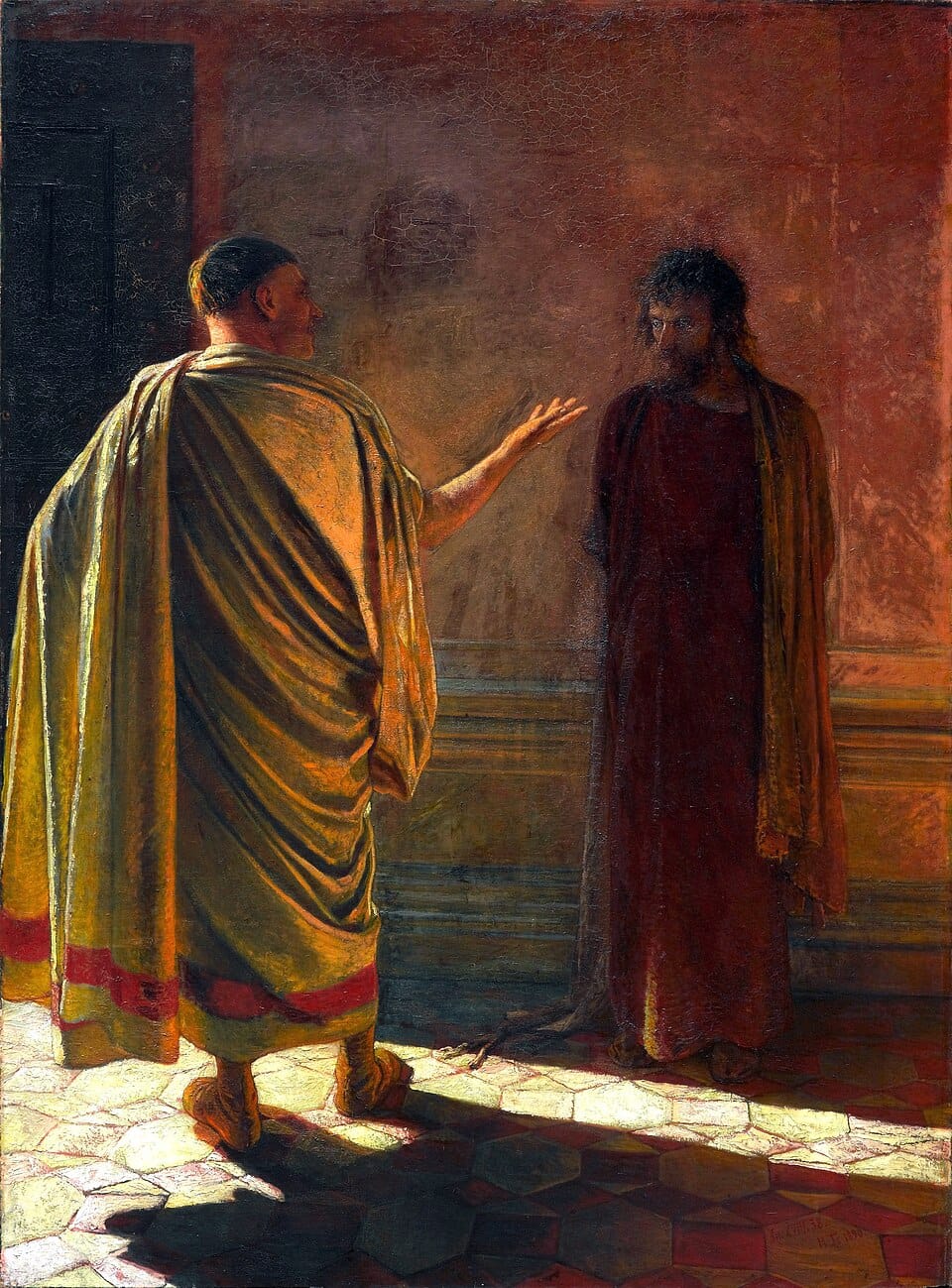
This brings us back to Pilate’s question. When he asked, “What is truth?” he stood face to face not with a definition, but with a Life. The tragedy is not that the question was asked, but that it was asked without waiting for an answer. Truth, in Scripture, often speaks quietly and requires time, listening, and humility.
Perhaps that is why the psalmist prays not for explanations, but for direction. Not for answers alone, but for guidance. Truth, according to the God of Israel, is something we are led into—step by step—by a faithful Guide.
And so the question lingers for every generation:
Are we merely collecting opinions, or are we willing to walk a path?
Do we want truth to affirm us, or to form us?
For those who are willing to wait, to learn, and to be led, truth is not lost. It is given. And it leads, always, toward salvation.