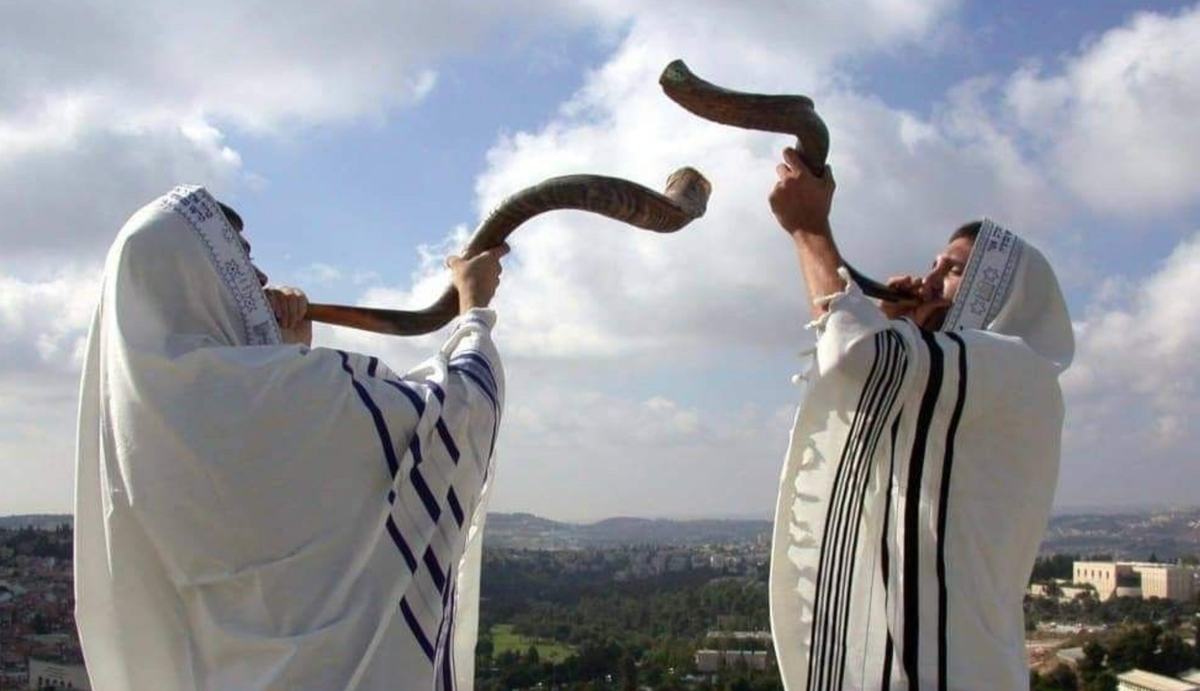
This week, I was awakened by the sound of a shofar—sharp, broken, almost crying. I looked at the calendar, following my guess.
Exactly.
The first day of Elul, the sixth and last month before the most solemn day of the Jewish calendar—Yom Kippurim.
My neighbours, Torah-learning Christians, announced the month by blowing the teruah—the distinctive nine short cries of Elul. A sound of awakening, preparation, and gathering for the coming King.
I wish you could hear it with me.
Why?
Because it is written:
אַשְׁרֵי הָעָם יֹדְעֵי תְרוּעָה יְהוָה בְּאוֹר־פָּנֶיךָ יְהַלֵּכוּן
“Blessed are the people who know the sound of teruah; O LORD, in the light of Your face they shall walk.” Ps. 89:16
Notice the logic of Eitan, the author of the song: people recognize this distinctive teruah sound and walk in His Presence.
Through three sounds, the Hebrew ear could read the news.
Tekiah — תְּקִיעָה. One whole breath to the very end. Proclamation. Gathering.
Shevarim — שְׁבָרִים. Three broken sounds, like groans, which awaken you to something big.
Teruah — תְּרוּעָה. The call to get ready before the King.
There is the forth sound, a very special - Tekiah Gadol which is believed will be accompanying the Messiah during His second coming.
“We shall all be changed, in a moment, in the twinkling of an eye, at the last trumpet. For the trumpet will sound, and the dead will be raised imperishable…” 1 Cor. 15:51–52
I have a ram’s horn at home but have never really learned how to blow it correctly. It carries my memory back to the ram caught by its horns in the thicket near the place of the Akedah, the altar of Isaac. Idea of substitution.
From that event, my thoughts fly to the parable of Elul that the Jewish people have carried through the centuries: “The King is in the field.”
The Mighty King on His way to His splendour palace makes a turn in the field, unrecognized by His subjects. Clothed in the garments of an ordinary man, He makes Himself available to His people.
His hand rests for a moment upon the sweat-darkened robe of a farmer struggling behind his plough, turning the dry, stone-ridden earth beneath the burning end-of-summer sun, preparing the stubborn soil for the early rains. Without a word, the King steps beside him and puts His own shoulder to the plough.
He passes a date orchard, heavy with the sweetness of the season. Men cut the great golden-brown clusters from the palms, while below, women and children gather them with laughter and bright voices. A basket, overflowing honey dates too heavy for one pair of hands. The Stranger bends down, takes hold of the other side, and helps to lift it.
When He looks closely into the tear-stained face of a grieving widow, she suddenly recognizes the features of her King. A cry of astonishment escapes her lips.
“It cannot be… You are the King!”
No trumpet announces Him. No royal garment betrays Him. No procession follows.
“The King is in the field.” You can approach Him right here—without lengthy admissions, guarded gates, endless waiting rooms, layers of reception, or the almost impossible protocol of gaining access to. No appointment, no credentials, no introduction by someone important.
His people do not yet realize how close He has come.
“He was in the world, and though the world was made through him, the world did not recognize Him. He came to that which was His own, but His own did not receive Him.” John 1:10–11
He stepped down to reawaken that original closeness, fidelity—אַהֲבָה (Ahavah/love)—in His people, to give them renewed hope before His return.
“So Christ… will appear a second time, not to deal with sin but to save those who are eagerly waiting for him.” Heb. 9:28
Elul — אֱלוּל. Its four Hebrew letters—א־ל־ו־ל, aleph–lamed–vav–lamed—are traditionally read as the initials of the words:
אֲנִי לְדוֹדִי וְדוֹדִי לִי
Ani le-dodi ve-dodi li
“I am my Beloved’s, and my Beloved is mine”
Song of Songs 6:3
It speaks of intimacy and love, of caring and mutual destiny.
Our Creator made Himself at home in our home environment, approaching us, seeing us and loving us as we truly are; inspiring us to be honest with ourselves and to get serious about working on ourselves, making the changes we know we need to make in order to become better versions of ourselves—closer to whom God intended us to be when He first breathed the breath of life into us.
During Elul, there is a tradition of reading Psalm 27—“The LORD is my light and my salvation; whom shall I fear?”—all the way toward the Day of Judgment.
Can there be any trembling fear before the One with whom you are intimately connected? Can there be any doubt of His total faithfulness and ultimate love for you?
The words — “The LORD is my light” are associated with Rosh Hashanah—Yom Teruah, the first of Tishrei (following Elul); “and my salvation” with Yom Kippur, the tenth of Tishrei; and “for He will hide me in His sukkah” point toward Sukkot, beginning on the fifteenth of Tishrei. He will hide me in His dwelling place in evil day.
But there is one verse that, for me, captures the heart of Elul:
“My heart says: ‘Seek My face.’
Your face, LORD, I will seek.”
So perhaps this is the simplest way to understand Elul: “Your face I will seek” and “I am my Beloved’s.” Before the shofar, before the Days of Awe, before Yom Kippur—an invitation from the Judge Himself, the Eternal King, to come closer.
A time when, in His intimacy, your inner world will respond to Him like to a great magnet—the eternal Source of life and love—realigning every cell toward Him.
This is my Elul.
This is my Beloved.
This is my destiny.
As a postscript, I want to share one of my favourite poem, which I carry with me since childhood. “The Doorkeeper” (1930) by Zinaida Gippius.
She captures profound understanding of Love and Judgment, embodied and personified. It is difficult to portray the full rhyme in English, what follows is only my feeble attempt. Whose who read in russian can find it here: https://ollam.ru/classic/rus/gippius-zinaida/pridvernik
The Doorkeeper
After Zinaida Gippius
Poetic rendering
If only I could reach the doorstep!
Eternal road… and strength is gone.
When suddenly, commanding, gentle,
The Person here… arrests my road.
And now I can see no farther.
White lights are shining from within.
An old man, standing at the doorway,
Signalling: “Stop here. Come and sit.”
Is this another weary longing?
Again—for ages, ages here,
Here at the threshold? Restless,
I turned and gazed upon the seer,
And straight began my lengthy story,
Confused, in haste, with troubled breath;
Repeating, penitent: “I’m guilty, guilty—
Of everything, beyond the rest!
No evil deed beneath the heavens
Have I not done throughout my life…”
The old man, with a smile austere,
Cut short the torrent of my words:
“Do not make haste! Whoever’s coming
At once is naming every sin:
‘They’ll sort mine out and surely pardon
The guilt of what my life has been.’
Each one is bearing many burdens;
You’re quick to take the blame for all.
Examine first what was your doing—
And find where you were not at fault.
Just think; sit here beside me,
And ask what your own heart may know…”
Again the ages… What are ages!
I couldn’t think of even one.
Like shadows passed my evil doings—
Pride, fear, persistence in the wrong,
Betrayal…
Wait a bit… Betrayal?…
Of that, on earth, I bore no blame.
I claim no merit for it, though,
Yet Love I never did betray;
No woman nor a friend, forsaken,
I left to grieve along my way.
Perhaps I face eternal waiting,
At this threshold, year after year;
Of treachery I stand here guiltless—
From that alone my soul is clear.
For other things I face the Judgment;
And let whatever comes, may come!
His trembling hand—the door swung open:
“Your wandering ends. No more to roam.
There is no Judgment.
Welcome Home.”
The original Russian poem by Zinaida Gippius, set to music by me.

Member discussion: