
Since the days of the Exodus, Jewish spirituality was centred on the Temple and its sacrifices. Yet after the Babylonian exile, something remarkable began to happen. Worship gradually became centred not only on the Temple, but also on the sacred Text itself.
When Ezra the Scribe returned from Babylon, he gathered the people to hear the Torah read aloud (Nehemiah 8:1–8). That moment marked the beginning of a historical transformation. The biblical writings became the focal point of Jewish faith. The Temple was rebuilt, but the public reading and study of Scripture were added.
Now, I would like you to picture the Mount of Blessing.
Many people imagine a dramatic cliff or rocky mountainside that is difficult to climb. It is not so. It is a grassy hillside flowing gently toward the inviting waters of the Kinneret.
It was here that Jesus delivered His famous sermon.
The Sermon on the Mount is known to everyone, yet its deeper meaning often remains difficult to explain.
Jesus said:
"Do not think that I came to abolish the Law or the Prophets;
A first-century Jew would almost certainly have heard:
הַתּוֹרָה וְהַנְּבִיאִים
ha-Torah ve-ha-Nevi'im, understanding the whole revealed Scriptures, or Old Testament for us.
The noun Torah derived from the verb יָרָה (yārāh), "to teach," "to instruct," "to point out," or "to direct,". It is God's loving instruction that points His people in the way they should walk. It is divine guidance for life.
“I did not come to abolish but to fulfil."
The Greek verb πληρόω (plēróō), translated "fulfil," does not mean "to abolish by completing." Rather, it means "to bring to fullness," "to carry to its intended purpose," or "to give its fullest expression."
The verbs abolish and fulfil are antonyms in this passage, helping us understand Jesus' meaning correctly.
Any student of the Second Temple period would have been very familiar with the language of the synagogues and the batei midrash (בָּתֵּי מִדְרָשׁ, "houses of study"), where rabbis spoke of לְקַיֵּם אֶת הַתּוֹרָה (leqayyēm et ha-Torah)—"to establish," "uphold," or "interpret the Torah correctly"—as opposed to לְבַטֵּל אֶת הַתּוֹרָה (levattel et ha-Torah)—"to nullify," "cancel," or "interpret the Torah incorrectly."
Thus, when Jesus declared that He came not to abolish but to perform fully the Torah, His Jewish audience would have heard familiar expressions.
The concept of building fences around the mitzvot (commandments) was one of the defining principles of Second Temple rabbinic tradition. In His programmatic Sermon, Jesus strengthens those fences by revealing their true purpose.
"For truly I say to you, until heaven and earth pass away, not the smallest letter or stroke shall pass from the Law until all is accomplished." (Mat. 5:17–18)
Jesus says that not even the smallest Hebrew letter—the י (yod)—or even the tiniest decorative stroke of a letter, known in Hebrew as a קוֹץ (kotz), will disappear from the Torah.
Look at the picture below.
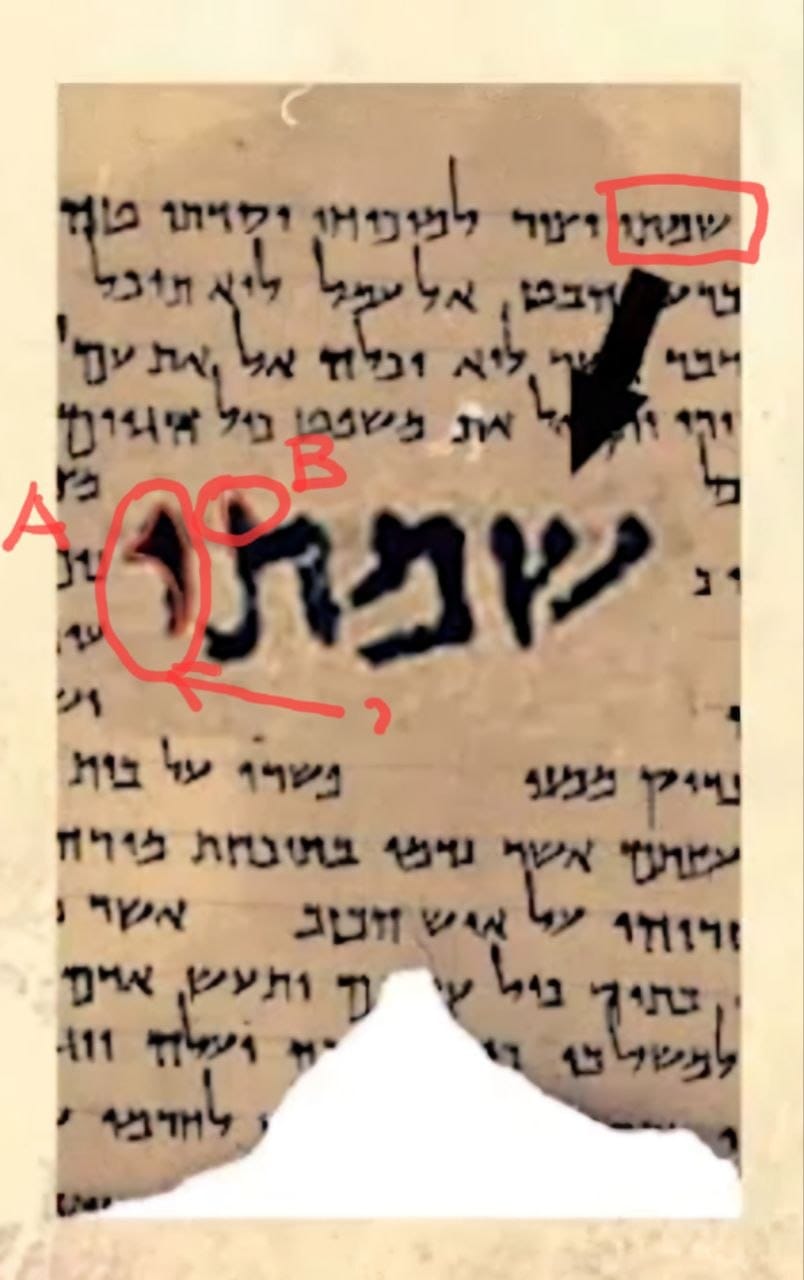
This is a fragment from the Dead Sea Scrolls, written in the style contemporary with Jesus' time. The top right word reads as שְׁנָתִי (shaftí) — "I judged". With “A” is marked the yod – the smallest letter of Hebrew alphabet. Next to “B” you see the tiny stroke above the letter tav (ת), which is not necessary for understanding the word. It is a calligraphic feature used by the soferim of that period.
Jesus deliberately chose an example that every Jew would immediately understand. His audience knew exactly what He meant.
The same reverence we find in Jewish oral tradition from that period.
"If the Torah is abolished in part, it is abolished completely. Solomon desired to abolish one yod from Me. The Holy One, blessed be He, said, 'Solomon and a thousand like him shall pass away, but not one yod shall pass from the Torah.'"
(Jerusalem Talmud, Sanhedrin 20c)
Whether historical or illustrative, the reference reflects the voice of its age. Every detail of Scripture mattered.
Jesus is not abolishing or altering the Torah in any way. He strengthens it by building protective fences around its commandments, exactly as respected rabbis of His day did.
Let us look at a few more examples and watch Jesus teach as a Rabbi.
"You shall not murder." (Exodus 20:13)
Jesus continues:
"You have heard that the ancients were told, 'You shall not murder,' and 'Whoever commits murder shall be liable to the court.' But I say to you that everyone who is angry with his brother shall be guilty before the court; and whoever says to his brother, 'Raca,' shall be answerable to the supreme court; and whoever says, 'You fool,' shall be guilty enough to go into the fiery Gehenna." (Mat 5:21–22)
Notice how the seriousness steadily escalates.
Jesus begins with the original commandment. Then, with the familiar rabbinic formula, "But I say to you," He moves one step further, making it more demanding.
The logic is simple. First come angry words. Then conflict. Then violence. Finally, someone ends up dead.
Jesus places obstacles on the road that leads to murder.
The commandment of Exodus 20:13 is reinforced by prohibiting the attitudes and speech that so often give birth to heavy stuff.
Another crucial teaching about our speech comes from the Book of Numbers. Notice how Jesus draws His teaching from the all the books of Torah.
"If a man makes a vow to the Lord or swears an oath to bind himself with a binding obligation, he shall not break his word; he shall do according to all that proceeds out of his mouth." (Numbers 30:2)
See also Leviticus 27.
Making vows is not a sin; the Torah allows them.
The problem was breaking them.
Jesus again moves in a more restrictive direction:
"But I say to you, do not swear at all... Let your statement be, 'Yes, yes,' or 'No, no'; anything beyond these is from evil." (Mat. 5:34, 37)
Here again He builds a fence.
If a person is known always to speak the truth, there will never be any need to reinforce his words with oaths.
Lets take another example from the sermon:
"You have heard that it was said, 'An eye for an eye, and a tooth for a tooth.'" (Matthew 5:38; cf. Leviticus 24:20)
This passage is more difficult to follow, yet the pattern remains exactly the same.
The Torah establishes justice through proportional compensation. You are not permitted to inflict greater harm than the harm caused by the offender.
Jesus pushes that principle in the most demanding direction. Instead of insisting on the minimum required by the Law, He calls His followers to go far beyond it.
He says, in effect, overcompensate.
Respond with more than justice requires. Go with generosity even when you have been wronged.
If we were to examine each of Christ's sayings, it would become obvious that He embraces all five books of Moses, making the mitzvot (commandments) of incredible significance.
He calls His disciples to a deeper and more radical obedience by building protective fences around the commandments.
Someone may object:
"But isn't that adding to the Torah?"
After all, Moses warned Israel:
"Whatever I command you, you shall be careful to do; you shall not add to it or take from it." (Deuteronomy 12:32)
It is a fair question.
Yet neither the scribes, nor the Pharisees, nor Jesus Himself believed that building protective fences violated the Torah.
The disagreement between Jesus and the religious leaders was never about that.
The real question was this:
Where should the fences be built?
Which fences reflected the heart of God, and which had become obstacles themselves?
When the Sermon on the Mount is read within its own Jewish world, the familiar picture begins to change. Jesus is not standing on the hillside building a new Torah stone by stone. He is standing there as a Rabbi, calling His hearers to its deepest and fullest obedience to the Torah given from the beginning. For He is the Author and the Imbodiment of all Scriptures.

Member discussion: